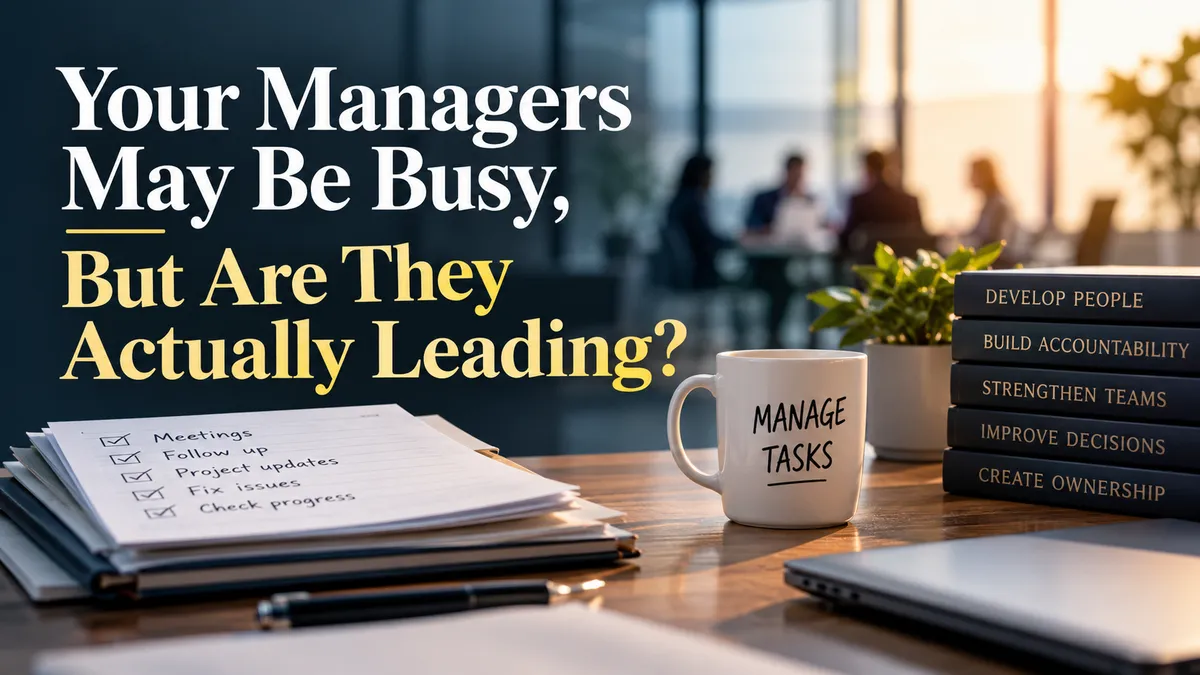
Your Managers May Be Busy, But Are They Actually Leading? |The Leadership Edge
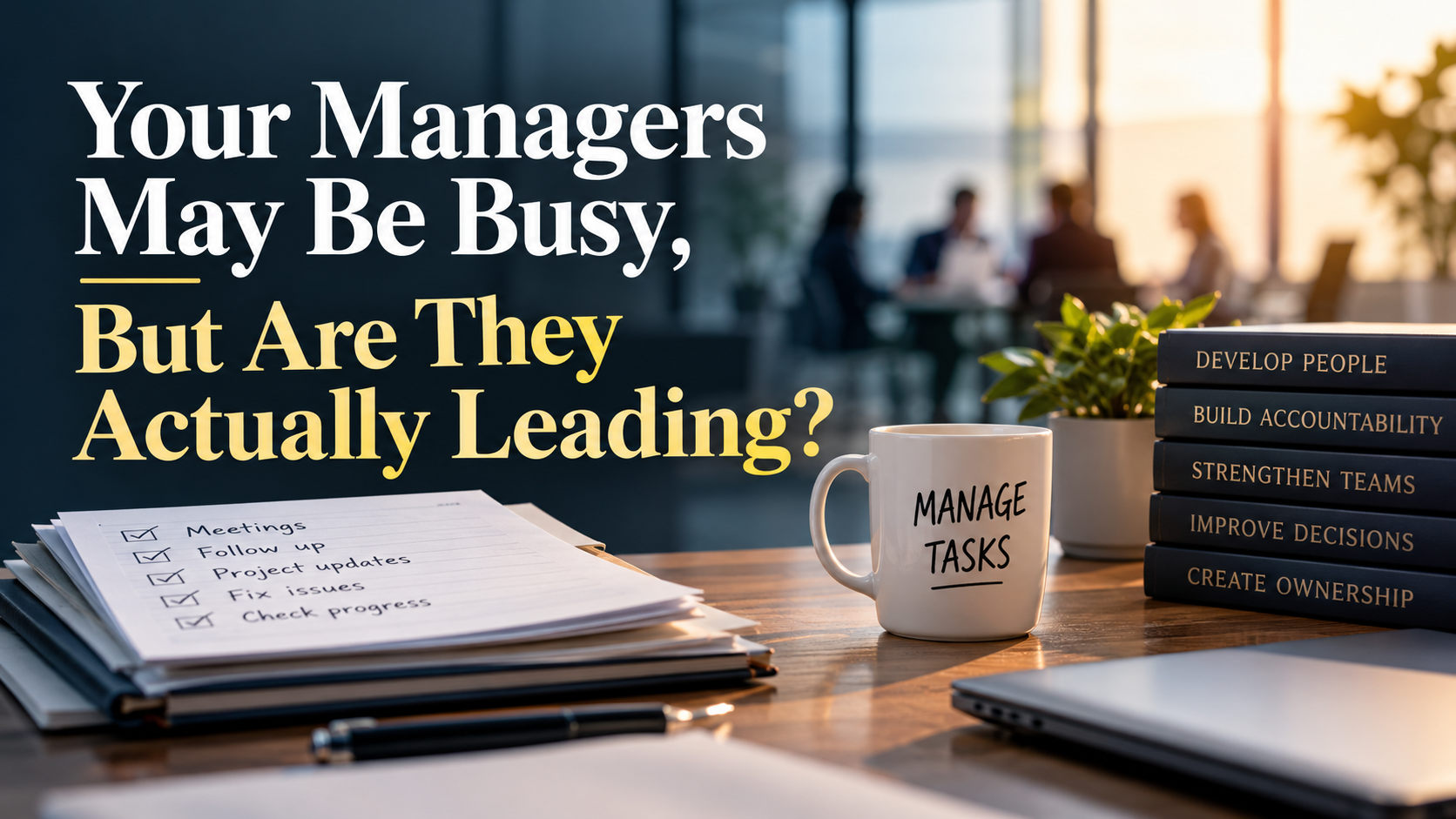
Your Managers May Be Busy, But Are They Actually Leading?
By Dr. Svetlana Papazov, Executive Leadership Advisor
Your managers are busy.
They are answering questions, checking progress, sitting in meetings, solving problems, and making sure the work gets done.
That can look like strong management.
But the difference between a manager and a leader is not how much they are doing. It is whether they are simply coordinating the work or helping their people become more capable, accountable, and independent.
A manager can stay busy all day without actually leading.
And when that happens, the business may have managers on the org chart while the owner or senior leadership team is still carrying most of the real leadership responsibility.
What Is the Difference Between a Manager and a Leader?
A manager organizes the work. A leader develops the people responsible for doing it. Strong managers need to do both.
Managing tasks means making sure deadlines are met, priorities are clear, projects stay on track, and day-to-day work gets completed.
Leading people goes further.
It means helping employees make better decisions, solve problems, take ownership, communicate clearly, and perform at a higher level without requiring constant direction.
That is where management performance begins to affect the entire organization.
A manager who only coordinates activity may keep the team moving.
A manager who leads helps the team become stronger.
Why Do Good Employees Sometimes Struggle as Managers?
One of the most common reasons is simple.
They were promoted because they were good at the work.
They knew the customer. They understood the process. They solved problems quickly. They were dependable.
Then they became responsible for people.
But being excellent at the work does not automatically prepare someone to lead the people doing the work.
Without leadership development, new managers often rely on the skills that made them successful before they were promoted.
They answer the question.
They fix the problem.
They jump into the project.
They check the details.
They make the decision.
It feels productive because things are getting done.
But over time, the team can become dependent on the manager instead of becoming more capable.
5 Signs Your Managers May Be Coordinating More Than Leading
1. Their Team Comes to Them for Every Answer
Managers should absolutely be available to their teams.
The problem is when employees cannot move forward without them.
If every decision, question, or problem lands on the manager's desk, the manager may be solving too much instead of developing the team's ability to think and decide.
Strong leaders do not just provide answers.
They help people become better at finding them.
2. They Spend Most of Their Time Putting Out Fires
Every business has problems.
But if a manager spends most of the week responding to emergencies, something deeper may be missing.
It could be unclear expectations.
Weak accountability.
Poor communication.
Confusing decision authority.
Or a team that has learned to wait until the manager steps in.
Leadership is not about becoming better at firefighting.
It is about reducing how often the same fires need to be fought.
3. They Focus Almost Entirely on Tasks
Task questions matter.
"Is this finished?"
"Where are we on that?"
"Did the client receive it?"
But stronger managers also think beyond the task itself.
They ask:
Does the employee understand why this matters?
Do they know what result they are responsible for?
Can they identify the next step without being told?
Do they understand which decisions they can make on their own?
That shift from monitoring activity to developing ownership is a significant part of becoming a stronger leader.
4. Difficult Performance Conversations Get Delayed
This is where many managers get uncomfortable.
An employee misses expectations.
Communication becomes inconsistent.
Deadlines slip.
Someone's behavior begins affecting the rest of the team.
Instead of addressing it directly, the manager compensates.
They fix the mistake.
Take work back.
Move responsibilities around.
Or quietly hope the situation improves.
That may reduce tension in the short term, but it weakens management performance over time.
Leadership requires addressing problems before they become patterns.
5. The Owner Is Still the Final Escalation Point
This is often the clearest sign that managers have not fully stepped into leadership.
Employees bypass their manager and go directly to the owner.
Managers escalate decisions they should be able to make.
Problems move upward instead of being resolved where they occur.
And the owner becomes the business's default problem-solving center.
Again.
When that keeps happening, the issue is not usually that the owner needs to work harder.
It is that leadership capacity has not expanded with the business.
Why Management Performance Matters More as a Business Grows
In a smaller company, the owner can stay close to almost everything.
They know what is happening.
They know the employees.
They know the customers.
And they can step in quickly when something goes wrong.
Growth changes that.
As the organization becomes larger or more complex, the owner cannot remain the decision-maker, coach, problem-solver, and accountability system for everyone.
The business needs managers who can carry more leadership responsibility.
That means making decisions closer to the work.
Setting expectations clearly.
Holding people accountable.
Developing employees.
Addressing issues before they reach senior leadership.
And creating enough trust that the owner does not feel compelled to keep checking everything.
This is why leadership development is not just an HR initiative.
It becomes a business performance issue.
Leadership Development Is More Than Giving Managers Better Tools
Companies often try to improve management performance with new systems.
New meeting structures.
Project management software.
Dashboards.
Templates.
Communication processes.
Those tools can help.
But they do not automatically create stronger leaders.
A manager can have a perfect dashboard and still avoid a difficult conversation.
They can have a great meeting agenda and still make every decision themselves.
They can use sophisticated project software and still fail to create ownership on the team.
Leadership development focuses on the behaviors underneath the tools.
How managers communicate.
How they delegate.
How they coach.
How they handle accountability.
How they make decisions.
And how they help other people grow.
One Question to Ask Your Managers This Week
Ask each manager:
"What are you still doing for your team that someone on your team should be learning to do for themselves?"
Then listen carefully.
The answer may reveal decisions the manager is holding onto.
Problems they repeatedly solve.
Responsibilities they have never fully delegated.
Conversations they are avoiding.
Or employees who are capable of more but have never been given the opportunity.
Then ask:
"What would need to change for you to step out of that responsibility?"
That conversation can tell you far more about leadership capacity than another status report ever will.
Strong Managers Create Capacity, Not Just Activity
Busy managers can keep the work moving.
Strong leaders create something more valuable.
They build teams that can think, decide, solve, and perform without everything flowing back through one person.
That creates better execution.
Stronger accountability.
More capable employees.
Fewer unnecessary escalations.
And more room for owners and senior leaders to focus on where the business is going instead of constantly being pulled back into the day-to-day.
The real question is not whether your managers are busy.
It is whether their leadership is making the people around them stronger.
Ready to Strengthen Leadership Before the Year Ends?
If capable managers are still relying too heavily on you, or leadership performance has not kept pace with the growth of the business, the Leadership Momentum Intensive is a focused six-week, 1:1 engagement designed to strengthen leadership, improve execution, and create greater organizational momentum.
It is an opportunity to identify where leadership friction is slowing the organization down and make meaningful changes before heading into the new year.
About the Author
Dr. Svetlana Papazov is an Executive Leadership Advisor and the founder of Leading Edge | Leadership & Management Performance.
She works with business owners, executives, and management teams to strengthen leadership, improve execution, and create greater organizational momentum. Her work helps leaders move beyond being the person everything depends on and build management teams capable of carrying greater responsibility as the organization grows.
Through advisory work and leadership intensives, Dr. Svetlana helps leaders address the practical issues behind stalled execution, unclear ownership, management performance, and leadership capacity.